

Flying Sites
Flying Season & Site Access
Both sites are typically active from spring through fall. Flying days are member-organized — check the SOGGI Message Board to see who’s heading out and when. New members are always welcome to join an experienced member for their first visit to either site.
Soaring at Sod Farms
Green Horizons Sod Farm, near Burford, ON

SOGGI thanks Green Horizons and sod farm owners for their support over the years in allowing SOGGI to fly on their fields.
It’s a nice day. The sun warms the countryside unevenly, creating point-to-point temperature variations. These temperature variations create 3 dimensional air circulation patterns that include areas of rising air (“Thermal Lift”). The pilot’s task is to fly the model sailplane into that “Lift”, so that the model will be drawn upwards by the Lift. This ability to climb without an engine is called “Soaring”.
Sometimes lift is scarce, so a protracted search for lift may be required. The spectacular ability to glide for great distances and for long periods of time is the defining characteristic of a good model sailplane. But if there is no Lift, then even the best sailplane will be forced to glide back home for an early landing.
When lift is found, half-hour flights are relatively common. A repetitive zig-zag search followed by circling in lift can cover many miles, all within sight of the pilot.
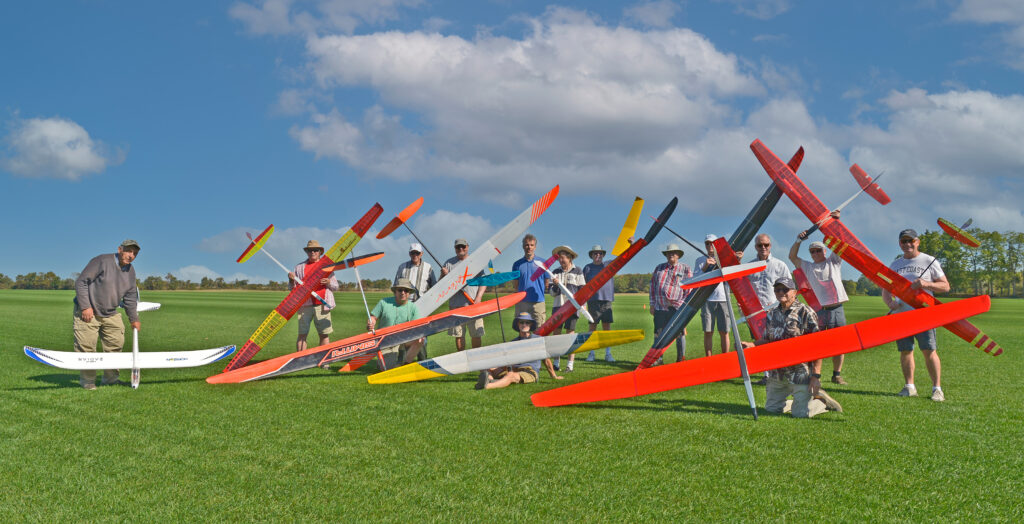
Before any search for lift can begin, the model must first be launched to an initial altitude of several hundred feet. For “pure” sailplanes, the launch effort is normally provided by an electric winch, or by a rubber bungee cord (more properly called a “Hi-start”). This launching tackle must be laid out on the ground parallel to the prevailing wind direction, so that the launch can be made squarely into the wind. Launch altitude is reached within a few seconds, at which point the aircraft is released from the launch line. The search for lift then begins.
After the launch-line drops to the ground, helpers retrieve the line to prepare for the next launch, and to prevent entanglement with the launch lines of other nearby winches.
Sod farms provide a large flat area that is free of obstructions, making it easy to lay out the launching tackle and to retrieve the launch lines.
And just in case you are caught far from home and struggling for altitude, it’s comforting to know that you can land nearly anywhere on a sod farm.
Sod farms can also accommodate some other soaring aircraft types, for example those with on-board electric propulsion systems, discus launch sailplanes, or even rubber powered freeflight models. “Freeflights” have no radio control system, but simply drift downwind while circling continuously. Even without an interactive means of control, they can still land safely on our large unobstructed flying sites. Click on Our Model Aircraft for more details concerning SOGGI’s various aircraft types and their launching methods.
Permanent markings and/or physical infrastructure are not permitted on the sod surface. Other techniques for organizing our field operations have therefore been developed. Considerations that go into the day-to-day set-up of our field operations are discussed on our Safety page.
A Record Worth Breaking
On July 12, 1985, Jack Nunn of Midhurst, Ontario flew 2 hours 47 minutes at a sod farm site near Cookestown, Ontario, to set the Canadian Open Thermal Duration Record for all sailplane classes — a record that appears to still stand. In the decades since, model sailplane design, construction materials, and radio control systems have all made spectacular advances. The time would seem ripe for someone to mount a challenge.
Slope Soaring
Westover, ON — leased from the Hamilton Conservation Authority
When strong winds disperse thermal lift and make sod farm flying impractical, slope soaring offers an excellent alternative.
When moderate to strong winds encounter an upward-sloping hillside, the air is deflected upward. By launching a sailplane into that deflected air from the top of the hill, the aircraft can rise with the upward flow and sustain flight indefinitely — as long as the wind holds. Be mindful of the back side of the hill, however, where the air flows downward and lift disappears quickly.
 Slope lift is typically concentrated and consistent. Given the right conditions and aircraft, skilled pilots can execute extended aerobatic flights or simply enjoy long, relaxed soaring sessions. Landings can be a bit more demanding than at the sod farm, so slope aircraft are generally built to handle some extra wear.
Slope Soaring Facts
FACT #1: The Canadian Absolute Duration Record for all types of R/C sailplanes is held by a slope soarer. On August 4, 1986, Robin Galway of Ottawa flew non-stop for 8 hours 47 minutes at a slope site near Montreal — edging out the previous record of 8 hours 15 minutes set by SOGGI’s own Stan Shaw earlier that same year.
FACT #2: The World Absolute Speed Record for all model aircraft types is typically held by highly specialized R/C slope soarers. Using a cyclical looping maneuver known as “dynamic soaring”. speeds can exceed 900 km/h.
